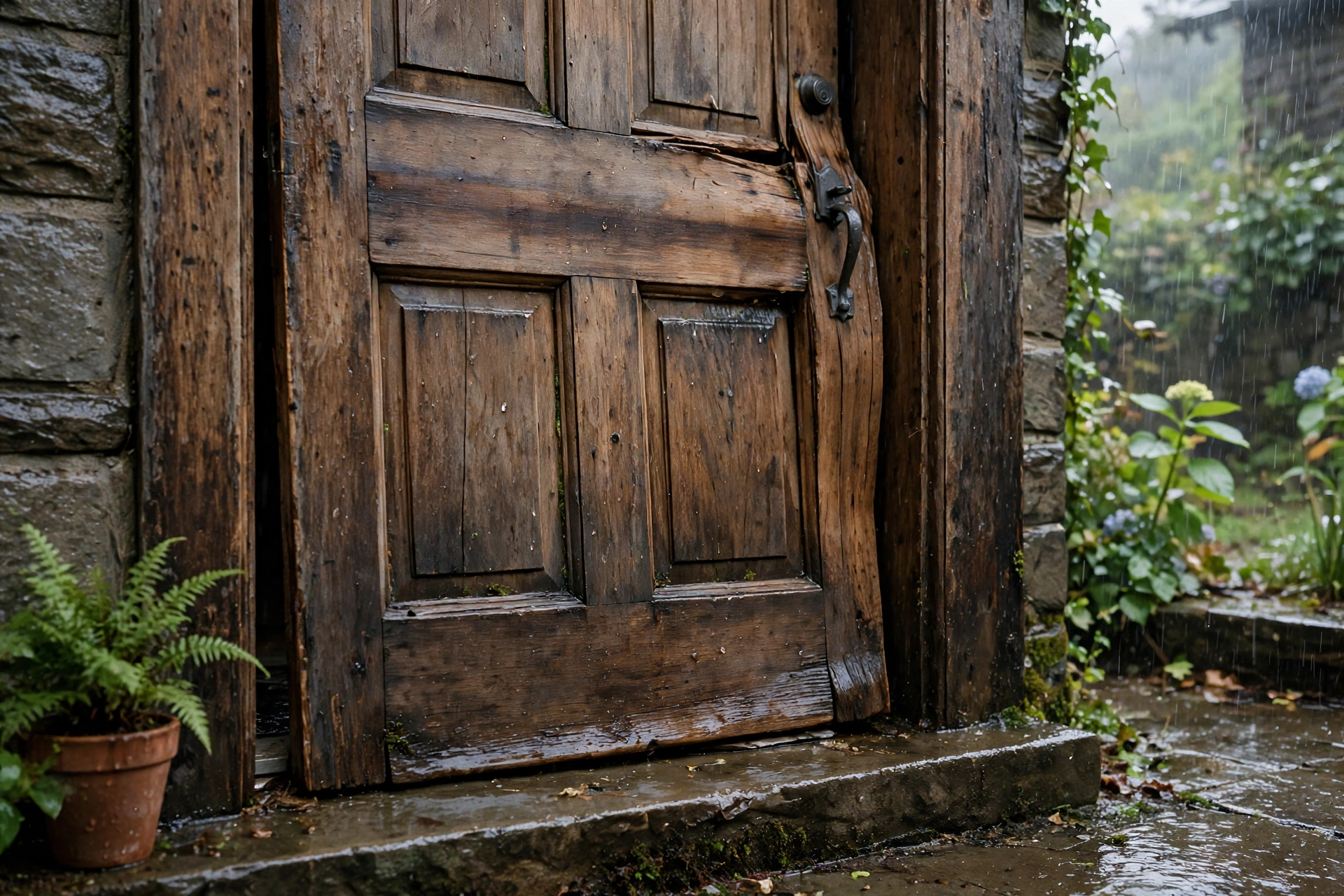
Why Do Exterior Wooden Doors Swell During Wet Weather and Become Difficult to Close Properly?
You push the front door shut, and instead of the familiar click it stops halfway, scraping the frame. Yesterday it closed fine; today, after a night of rain, it feels as if the door has grown overnight. In a sense, it has: a wooden door takes water into its fibres, and that water changes its size just enough to erase the slim clearance it was fitted with.
The usual instinct is to reach for a plane straight away, but trimming at the wrong moment can leave a draughty gap all winter. Knowing what is happening inside the wood, and in what order to act, separates a lasting fix from one repeated every rainy season.
The Short Answer: A Timber Door Drinks Moisture and Grows Across Its Width
Exterior wooden doors swell in wet weather because wood is hygroscopic: it absorbs moisture from humid air and wind-driven rain, and its fibres expand as they take that water in. Growth happens mostly across the grain, so a door gets wider and thicker rather than taller, and the latch side and bottom edge usually bind first. A door fitted with only a millimetre or two of clearance can therefore start sticking after a single prolonged wet spell.
Most swollen doors are a maintenance problem, not a sign the door is ruined. Once the wood dries, much of the swelling reverses, and sealing the bare edges that let water in usually stops the cycle repeating. The exceptions are doors that have started to rot, or frames that have moved, covered later in this article.
How Timber Takes In Water and Why the Width Grows Most
Timber is a bundle of long, hollow plant cells whose walls are made largely of cellulose, a material with a strong attraction to water. When damp air surrounds a door, water vapour moves into the cell walls and pushes the fibres apart, a process woodworkers call moisture-induced expansion.
Two details matter when diagnosing a sticking door. First, wood swells far more across the grain than along it, so width and thickness change noticeably while height barely moves, which is why a swollen door rubs on the latch side or edges. Second, the movement is uneven: end grain at the top and bottom edges drinks water far faster than the flat faces. A door that looks well painted can still soak up moisture through an unsealed bottom edge, which is why the bottom is so often worst affected. Dense hardwoods and stable-core engineered doors move less than softwoods, but no wooden door is immune if its finish has worn thin and it sits in driving rain without a porch above it.
Reading the Rub Marks: What Each Sticking Spot Says About Your Door
Before touching a tool, find exactly where the door binds. Close it slowly, or slide a thin sheet of paper around the gap: where the paper grips, the door is tight. The pattern reveals the cause and stops you planing an edge that was never the problem.
Also look for rub marks: a shiny or compressed strip on an edge, or paint dust on the frame, shows where it binds. Soft or crumbly timber near the bottom edge points to rot rather than simple swelling.
Wet Weather Is Not Always the Whole Story: Hinges, Paint and a Shifting Frame
Several other faults produce the same symptom and each needs a different fix. Loose hinge screws let a heavy door droop so its top latch corner catches. Years of repainting can add enough thickness to close up the clearance on their own. And a frame can shift as a house settles or damp affects the surrounding wall.
The weather test separates these causes. If the door sticks in wet weeks and frees up when it dries, swelling is likely. If it sticks all year round, suspect hinges, paint build-up, or frame movement. A door sticking in one corner only also hints at hinges, since swelling binds along a longer stretch of edge. Checking hinges first costs nothing and avoids planing a door that only needed a longer top-hinge screw.
A Calm First Response: Drying the Door Before You Cut Anything
The most valuable advice about a swollen door is also the hardest to follow: wait, and dry it out first. Wood swollen with water shrinks again as it dries, and a door planed while at its fattest will rattle in its frame once dry weather returns.
- Let it dry: Wait for a few dry days, improve ventilation around the door, and run a dehumidifier if the house is humid inside.
- Tighten the hinges: Tighten every hinge screw; if one spins freely in a stripped hole, replace it with a longer screw biting into the framing behind the jamb.
- Cut off the water supply: Clear debris from the threshold, check rainwater drains away from the sill rather than pooling against it, and inspect the weatherstripping.
If the door frees up as it dries, the fix is mostly about sealing, not cutting. If it stays stuck through a dry week, the problem is mechanical, and trimming or hinge work is next.
Trimming a Swollen Door Edge Without Creating a Draughty Gap Next Winter
When drying and hinge checks have not freed the door, careful trimming is the right move. Remove the smallest amount of wood that restores a smooth close, leaving an even gap of roughly 2 to 3 millimetres around the sides and top, with a little more at the bottom. Remove too much and you trade a sticking door for a draughty one.
- Mark, don't guess: Close the door and pencil where it binds, using the paper test or the shiny rub marks.
- Remove a little at a time: For a small high spot, a sanding block is enough; for a longer tight stretch, a sharp hand plane leaves a straighter edge. Take off a thin shaving at a time, testing often.
- Remove the door for top and bottom edges: Take the door off its hinges for top or bottom edges, which are awkward in place, and support it flat so it cannot twist.
- Smooth and seal immediately: Sand the trimmed edge smooth and seal the raw wood the same day with primer and paint or varnish. A freshly planed edge left bare drinks the next rain faster than the old edge did.
Work safely: plane away from your body, keep hands behind the cutting edge, clamp the door rather than holding it freehand, and wear eye protection and a dust mask when sanding. If old paint could predate lead-paint restrictions, get it checked before sanding.
Sealing All Six Sides So the Next Downpour Has Nowhere to Get In
The long-term fix for a swelling exterior door is not trimming but sealing, and the detail most often missed is that a door has six sides: front, back, two long edges, and top and bottom edges. Painters often coat the faces and latch edge but leave the top and bottom edges bare because nobody sees them, and those absorb water fastest.
Start with a sound, clean surface: scrape off flaking paint, sand lightly, and prime bare wood before topcoating. Exterior paint or varnish both work as moisture barriers provided the coating is continuous; a single crack is a doorway for water. Pay particular attention to the bottom edge, panel joints, and areas where locks and hinges break the coating. Recoating every few years, before the finish visibly fails, is far cheaper than dealing with a swollen or rotting door. Worn weatherstripping and a damaged threshold deserve the same attention.
Keeping an Exterior Timber Door Dry Through the Wet Season
Once fixed, a short routine each wet season keeps it that way:
- Check the top and bottom edges for intact finish, and touch up bare or cracked spots.
- Clear the threshold and drainage channels of leaves, grit, and standing water.
- Check weatherstripping for compression, tears, and gaps; replace worn lengths.
- Tighten hinge screws and lubricate latch and hinges lightly, wiping away excess.
- Check the canopy or porch above the door: a leaking gutter there undoes all other maintenance.
- Keep hallway humidity moderate with ventilation or a dehumidifier, since a door absorbs indoor moisture too.
For a south-west facing door with no porch, a storm door or canopy is often the most effective improvement, since it keeps driving rain off the timber.
When a Swollen Door Has Crossed From Annoyance Into Rot or Frame Damage
Most swelling is reversible, but a door that has stayed wet for a long time can cross into damage no drying or planing will fix. Call in a carpenter or joiner, rather than persisting with DIY, if you find soft, spongy, or crumbly timber, especially along the bottom edge or around the lock, since that usually means rot. The same applies if the frame is twisted, cracked, or pulling away from the wall, or if the lock no longer engages securely, since that is a security issue. A professional can judge whether repair is sensible or replacement with a more moisture-resistant door is better.
What Fixing a Swollen Exterior Door Tends to Cost, in Rough Terms
Costs vary by region and door size, so the figures below are broad estimates only, not quotes.
Drying, sealing, and a careful trim cost a fraction of a replacement, so work through them in that order. Replacement makes sense when rot is extensive, the door has been trimmed repeatedly and now sits loosely, or its insulation and security are poor by modern standards.
Swollen Exterior Door Questions Homeowners Ask When the Rain Sets In
Will a swollen exterior door shrink back on its own once the weather dries?
Usually, yes, at least partly. Wood gives up moisture as the air dries, and the door shrinks back over days or weeks, which is why waiting for a dry spell matters. If it never fully returns to its old fit, some movement may have become permanent, or the finish may have failed.
Is it safe to plane a door while it is still swollen?
It is possible, but risky: a door planed at its wettest will be too small when it dries, leaving draughty gaps. If you must plane in wet weather, remove the minimum and seal the edge immediately.
Why does only the bottom of my exterior door stick?
The bottom edge is usually the least well sealed and most exposed to standing water and splashing. End grain there absorbs water quickly, so it swells first and most. Check its finish and sill drainage before assuming the whole door is at fault.
Can I use a hairdryer or heater to dry a swollen door faster?
Gentle, moving warm air can help short term, but concentrated heat can crack the finish, scorch the timber, or warp the door. Keep any heat source moving and at a distance, treating it as a temporary easing while you fix the moisture source, not the cure.
Should I replace a wooden door with fibreglass or steel to stop swelling?
Not necessarily. Fibreglass and steel doors do not absorb water the way timber does, but a well-sealed modern wooden door performs well in most climates, and many homeowners prefer its appearance and repairability. Consider replacement when the door is rotting, has been trimmed repeatedly, or sits in a chronically wet spot.
How do I stop my exterior door swelling again next wet season?
Seal all six sides, especially top and bottom edges, keep weatherstripping and threshold in good order, clear sill drainage, and protect the door from driving rain with a canopy or storm door where possible. Inspect at the start of each wet season to catch failing finish early.
A Door That Closes Cleanly Again, Even in the Wettest Weeks
A swollen exterior door is rarely a mystery once you know what to look for: timber absorbs moisture, grows across its width, and binds where clearance was tightest. Dry it before you cut it, check the hinges, trim only as much as you must, and seal every edge, including the ones nobody sees.